When I was rifling through boxes of books recently in a failed attempt to properly unpack them, I came across an H.P. Lovecraft anthology I did not remember owning. But my focus has been shot to hell recently (see: 2020) and short stories seemed about all I could handle. In October I worked through reading Lovecraft Country (not as good as I hoped) and then Victor LaValle’s novella, The Ballad of Black Tom (surpassing all expectation), both of which reckon with Lovecraft’s blatant racism – an unignorable factor in his writing.
I have never been into Lovecraft, although I remember trudging through The Dream-Quest of Unknown Kadath in college, but the anthology I found intrigued me and I spent a couple of weeks reading some of his more popular stories – At the Mountains of Madness, The Dunwich Horror, The Shadow Over Innsmouth. However, this is about one story that proved to be at the genesis of a narrative pattern I am constantly drawn to – The Color Out of Space.
Let’s actually start with the spring of 2016, when movie theaters were still open. The Charles in Baltimore was doing a revival of Stalker, a three-hour 1979 Andrei Tarkovsky film about three men walking through an alien minefield searching for an idol that will grant them their wish. I was in a new relationship at the time and I agreed to go mostly so I could sit next to this guy in the dark for three hours. But reader, I was hooked on this film (also, consequently, the guy). In retrospect, it’s a movie that works best in a dark theater. I cannot imagine trying to watch it at home, with your phone and your computer and your cat yelling at you and no strangers to shush.
From the first ten minutes I was drawn into its quiet dreary slowness, the constant sound of trickling water in a place left behind, bucolic but rife with unseen and unknowable danger. It is an obvious allegory for nuclear fallout. As it was released seven years before the Chernobyl disaster1 set the standard for fallout horror, watching it feels like a premonition.
I tell people about Stalker a lot, but it’s a hard sell. It is not paced for modern audiences; it doesn’t want to impress anybody. It’s more like an art film than a science fiction movie. Because of that I often recommend reading the 1972 novella it’s based on – Roadside Picnic by Arkady and Boris Strugatsky.
After seeing Stalker for the first time I went on a bit of a deep dive trying to find fiction akin to it. It is nominally sci-fi, but an odd kind of slow burn that is hard to pinpoint. The lesson is not heavy-handed, but it’s there; human influence on nature, the invisible havoc of industrial pollution, fallout, and waste. Rachel Carson released Silent Spring in 1962 and the environmental movement had birthed an awareness of our collective human tread, and a recognition of the vast web of life into which we were punching holes. Stalker built on these themes in a way that I can now only describe as Lovecraftian – the creeping horror – and it hit me deeply, pulling at my own latent anxieties. But it also lit a perverse hope. Perhaps we cannot destroy everything. Something new – however horrible – will at least remain.
It was not until I read Jeff VanderMeer’s Annihilation that I found anything close to it. My love of both the book and the 2018 movie are widely known because I will not shut up about them. I went so far as to download the soundtrack and listen to it on repeat for the better part of a year. Annihilation is in many ways the same movie as Stalker – a quest through alien dangers, a final goal, a transformation2. A lush landscape mired in deep wrongness by a twist in the scaffold of life – the “shimmer.” The very name recalls Lovecraft’s Color. The horror of it is best underlined for me by the bear, which terrified me so fully that I blocked out my memory of the entire scene until I finally watched the movie again six months later.
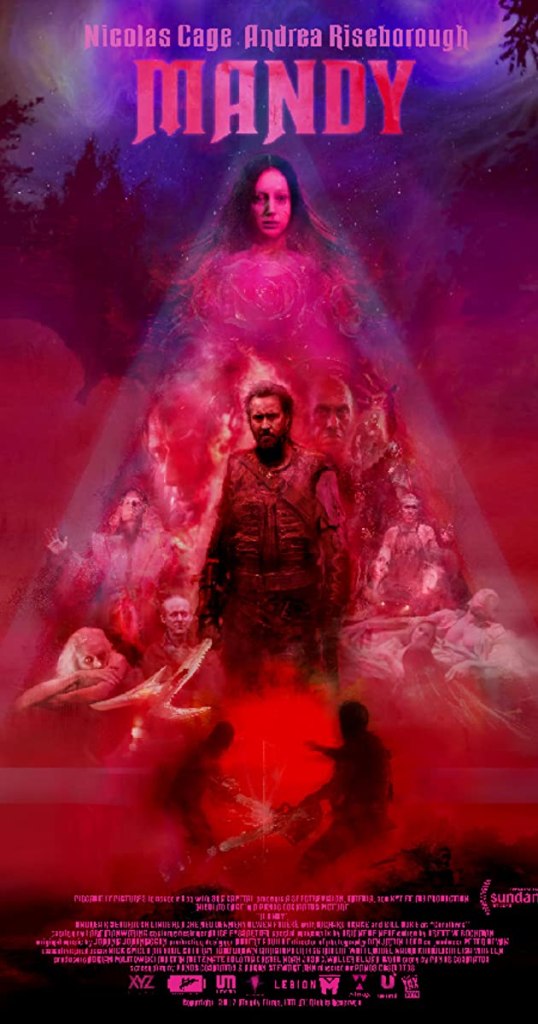
But where does Lovecraft come into all this? Over the summer I watched the new Color Out of Space adaptation starring Nic Cage. It was mostly on a lark – I cannot take Nic Cage seriously, and I had never even heard of the Lovecraft story. The movie does not match the artistry of either Stalker or Annihilation, but the lighting is otherworldly and Nic Cage yells a lot. It is equally slow-paced, if a little more grotesque. It felt to me like a rougher attempt to hit the same sweet note.
But the use of color in Lovecraft’s story is one of the most perceptive things about it – because nuclear radiation and color operate on the same electromagnetic spectrum. Ionizing radiation itself is beyond our sight, something malicious, incomprehensible, alien, especially in 1927 when Lovecraft wrote the story. When Marie Curie discovered radium twenty-eight years earlier, the pale blue glow became popular in everything from cosmetics to aircrafts3. Radium’s light-emitting properties were touted as beneficial, and users believed radiation itself was both visible and knowable, even as evidence of its invisible dangers mounted.
The world was caught between the promise of better living through science, and meddling with forces it did not have the means to control. This is Color Out of Space in a nutshell, and when I finally read it – actually read the original short story – I was so astonished, so ecstatic to find this kernel of inspiration for so much of the media I enjoy and I wanted to yell at someone for not telling me sooner.
We can get farther into nuclear semiotics or radiation accidents or genetic mutations, all of which influenced the piece I did in 2018 called Atomic Garden, but for now I’m just glad I found the narrative nexus on which so many of my favorite stories rest. If you have recommendations for books or movie based on these themes, please comment! If you have evidence of radiant horror before 1927 – I want to be all over that! Load me up with all your nuclear anxiety media, I am here for it.
Notes:
1see: Midnight in Chernobyl
2see: Hero’s Journey
3see: The Radium Girls
 Allison E. Fischbach