Media Literacy, Disinformation, and Free Speech

Archives and Libraries, Reccomendations

I signed up for Facebook in June 2006, right after I washed my hands of high school and got ready for the seriousness of college. A friend who had graduated the year before invited me to the website, and I was eager to find other people who were headed to my tiny liberal arts campus.

Facebook was young then and still limited to students with an .edu email address. I used it prolifically for years – to share jokes, memes, media, to chat with classmates and friends, to build an image of myself – but I have a distinct memory of thinking, “When will I not be on Facebook anymore?” It was a kid thing then, a thing young people did – where was the line? When would I retreat from this juvenile space and build for myself instead something more professional, more opaque?

Social media has changed dramatically in the past fifteen years, and the time has long come for me to leave it. The way these websites operate has become increasingly detrimental to our personal self-image and our social discourse. As social media shifted its model to data mining that profited off of every post we make – with little regard for the actual content – I decided I was tired of giving them any more information to spin into gold.

But I think it’s also worth examining how social media can be used in a new, more equitable world. Part of that goes hand-in-hand with information literacy. Libraries and archives and every high school class I ever took were big on this concept of understanding, evaluating, and integrating knowledge to answer questions.

Did Media Literacy Backfire?

This article from danah boyd does an exceptional job of parsing why disinformation has taken hold in the age of information literacy – and how the concept itself can facilitate disinformation rather than hinder it.

The entire series of articles from Points is exceptional, and strikes at the disingenuous idea that simply teaching media literacy can stop this wave – to do so is like slapping duct tape on a breaking damn. It does not address the core problem, and it will not be enough. We have to better understand the problem in order to rectify it – and at the danger of sounding anti-free speech – content moderation may in fact be the best tool we have.

Are There Limits to Online Free Speech?

Which is why I’d also recommend reading this article from Alice Marwick, that examines how the promise of a self-regulated internet built in the grand tradition of the Forum became a place where intolerant ideas could spread unchecked.

Content moderation by private technology companies is not a First Amendment violation; in most cases, it’s just a matter of enforcing pre-existing Terms of Service. But this victim/bully dichotomy allows them to garner sympathy from many who truly believe that the internet should be a stronghold of free speech.

Marwick shaves close to Karl Popper’s Paradox of Tolerance in this article. Mainly, that in order to foster a free, tolerant and accepting society, there must be limits against intolerant thought and behavior.

“If we extend unlimited tolerance even to those who are intolerant, if we are not prepared to defend a tolerant society against the onslaught of the intolerant, then the tolerant will be destroyed, and tolerance with them.”

I find that this is an increasingly self-evident truth. That we as a society must enforce what behavior we find appropriate. It is disingenuous to argue that fighting against intolerance and purposeful misinformation is akin to censorship – it is still illegal to shout fire in a crowded theater. We must take action before the consequences become so dire.
Welcome to the Labor Camp

Archives and Libraries, Art

I am entering the second year of my Master’s in Library and Information Science, with a focus on archives and digital curation. One of the tools we use a lot is Omeka. Omeka is a platform used by galleries, libraries, archives, and museums to host digital materials and related metadata, as well as create exhibits. What it basically does is organize your stuff and let people search it from the comfort of their own home.

It’s also free. This means that everyone uses it. Every time I have a new Omeka project, I have to make a new account. I have made four – FOUR – separate Omeka accounts in the past year. I’m out of email addresses to sign up with. It’s truly madness.

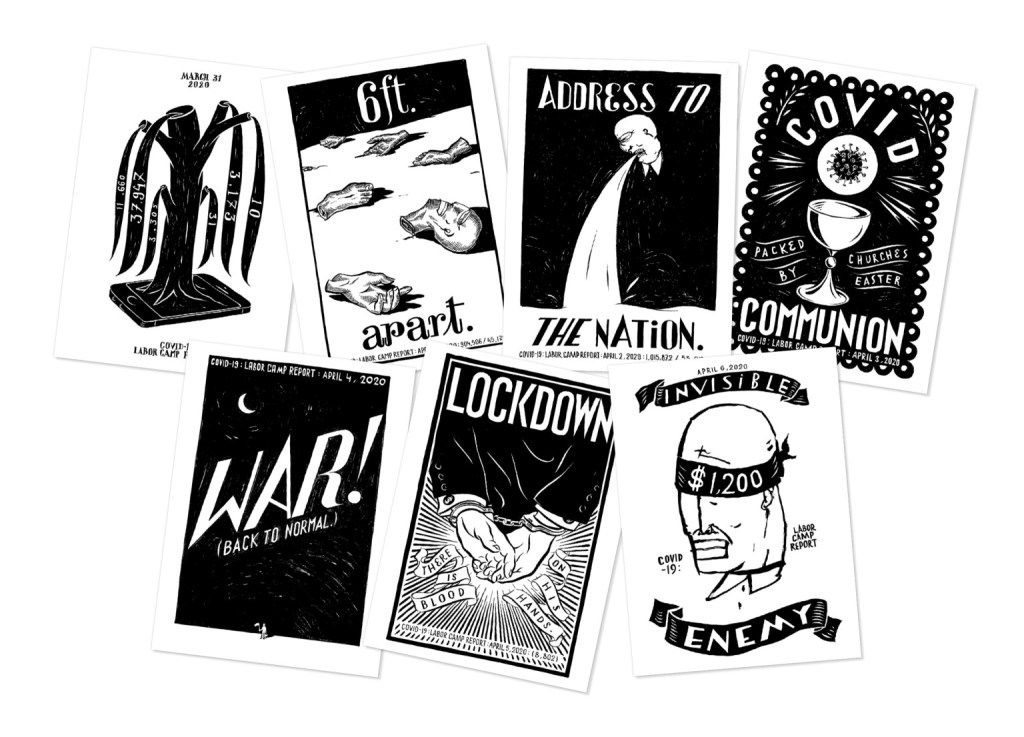
For my last Omeka project (hopefully ever) I created this exhibit about artist Pitor Szyhalki’s COVID-19 Labor Camp Reports. Szyhalski created a broadside a day from March 24 to November 3, 2020, responding to the myriad crises America faced almost daily as the COVID-19 death rate soared in the run up to the 2020 presidential election.

Welcome to the Labor Camp (exhibit link)

Post Typography in Baltimore printed and wheat-pasted the broadsides all over the neighborhoods I frequented this summer – Charles Village, Old Goucher, North Ave., Bolton Hill, Mt. Vernon – and that was where I first saw them plastered on breaker boxes as I biked up and down Howard Street.

I’m not going to say a whole lot more about these because most of what I have to say is covered in the exhibit, but these images astounded me. I do not have any rapid-response ability when it comes to art, so the perceptiveness of the pieces is doubly impressive. Szyhalski has an eye for graphic design and a mastery of visual language. There is a collected book in the works, and you can purchase selected posters on the Frank webpage, and follow on Instagram for the entire collection.

What We Don’t Have

Archives and Libraries

What We Don’t Have

I want to post this exhibit from Carnegie Mellon University because it is a strong example of how archives have historically and continue to uphold white supremacy and white histories, and how they can work to change this fact.

This exhibit is a not just an acknowledgement of the way white supremacy has marginalized diverse actors in the school’s history, but it is also a call to real action on the part of CMU to thoughtfully and collaboratively recognize a fuller story.

Archives are missing many histories. This stems from their origins as a means to uphold institutional power – especially in a culture where written documentation, literacy, and the ability to preserve physical objects form the foundations of that power. In this construction, people without the means to read, write, or preserve records are disenfranchised because they lack appropriate “evidence” of their own lived experiences.

Because of a tradition of ignoring marginalized communities and non-western modes of documentation, when members of these communities come to archives to find their histories, it’s oftentimes hard to help them. We simply do not have the records. This contributes to the idea that people who are non-white, non-western, and non-heteronormative simply did not exist in the past. It’s called “archival power;” the ability to codify history and shape collective memory according to a specific set of standards. It is a false image of history and it is detrimental. How can a community form a cohesive understanding of who they are without understanding where they have come from?

Time and time again the destruction of social histories has ripped apart the fabric of communities. It was evident in the proliferation of American Indian Boarding Schools in the US and Canada, and evident in the severing of families during chattel slavery the United States. Shared social histories provide stability and purpose, and are necessary to the human condition, understanding ourselves as individuals, and our place in a community. I think about how much I know about my own family history and how that shapes my self-image. It is the foundation that allows me to move through the world as an actualized person, and it has been taken away from so many people in favor of upholding a white, western status-quo.

This is changing as oral histories and alternative means of expression become recognized as valid documents of historical experience. Re-thinking what constitutes a “document” or record in archival parlance is essential to deconstructing traditional archival power. At the same time, CMU put it well when they say:

“Still, we acknowledge that for members of marginalized identity-based groups… it may be difficult to entrust the University Archives with their story when we do not have a history of engaging with them or recognizing their substantial contributions to campus life and culture.”

Relationships between power and communities is the most fraught part of rectifying these historical gaps. Marginalized groups have little reason to trust institutional archives when they have been at best ignored, and at worst actively harmed by these repositories.

During protests against a private police force at Johns Hopkins University in 2019, school archivists were in the crowd asking for donations of posters and other protest materials to the university archives. While the archivist side of me understood the impetus for rapid-response collecting, as an individual outside the institution (I lived about 4 blocks from campus at the time), the presence of university employees soliciting evidence of my involvement felt potentially dangerous.

How would these items be examined, cataloged, or presented in the future? Would names or faces be linked to individuals in a way that could lead to potentially harmful action against them? This certainly happend during Black Lives Matter protests, where video and photographic evidence posted to social media put activists and protesters in the sights of law enforcement long after they left the street. How could I be expected to trust the institution whose actions I was actively protesting? This is the gap many archives must work to rectify.

Without acknowledging past harm, recognizing and working to avoid the possibility of future harm, and rebuilding trust through thoughtful, meaningful, and mutually beneficial partnerships, there is little ground on which to stake reconciliation.

CMU is setting an action plan for this reconciliation. Only time will ultimately tell its success, but it is a powerful example of how archives – including mine – can be called to action in order to rectify past wrongs and create a fuller, more truthful, more impactful awareness of our shared history.