Videos for When Time is an Abstract Concept

Art, Reccomendations

Pandemics are weird. Some nights I go to bed at 9 o’clock because I’m exhausted from making my brain process consciousness. Some nights I am awake until 2am trading trippy animated videos with Mason. Here’s a couple things for your late night/early morning/time is an abstract concept viewing.

This is not animated BUT I watched a hypnotic Tictok with this song, which led me here. There is not a Tictok that could be made to rival the live performance.

Mason also had me watch this (The Secret City). It’s an educational PBS kid’s show from the late 80s and I LOST MY MIND. I know basic art concepts and this was still incredible. I felt like I needed to take notes. Watching this guy teach you about foreshortening is like watching magic happen, and he’s telling you HOW it happens and that it’s not magic, and I’m still thinking “no… that’s obviously magic.” It makes me FURIOUS. How do you WHIP IMAGES RIGHT OUT OF YOUR HEAD LIKE THAT. I have never been an illustrator or an animator and I am baffled. Grab a pencil and draw some shit with Captain Mark.

All I get to listen to now is the new Wax Tailor album. This video isn’t really much, but the song features Mark Lanegan so here ya go.

OH this would be a time to recommend “The Midnight Gospel”. I am not going to endorse all the views, or beliefs, or esoterica that is in this series, but what really drew me to it (aside from the animations) is the earnestness. The genuine desire for connection and understanding. It is refreshing right now because I miss my friends, and I miss strange, honest conversations, and it is soothing to hear people talk and listen to each other. It won’t change your life, but it might make you feel better for a bit.

(If you like it, listen to the Duncan Trussell Family Hour.)

Comments are open link some weird videos.

Today We’re All Just Gonna Listen to St.Vincent

Reccomendations
The Leopard Print Onesie Suit is essential attire.
David Byrne Still Got It.
Women & Women First is one of the most painful recurring skits I’ve ever seen.
Focusing on anything is absolutely impossible. Moreso lately.
At least it’s getting warmer. I saw a hawk in the yard last week.
And I’m getting a new tattoo today.
I’m resisting the urge to do an undercut again, but I already bought the hair dye.
I need a change I am in control of after this stupid ass winter.
Wishing you an ardently good week.

BONUS CONTENT
PseudoPod 747: Keeping House

Insomnia

Writing

A writing exercise.


It is 1.17am. Okay. It’s not yet official that I cannot sleep, but almost. There are a few choices here. I can turn back over and try to simply shut down like a tube TV, blinking out in a loss of static, but I’ve been doing that for the past hour and here I am. I can try to think about the exercises my therapist gave me last year, the breathing and the mind clearing. That was not a new lesson – I learned the same things in college during that terrible freshman year. It was the Lexapro that worked then as much as the meditation, but I don’t need that now. The problem is much larger and harder to correct than a chemical imbalance. 

When I think of banishing my thoughts I think of slips of paper sailing into a void; there they go, sliding away from me. They came, and now they are going, and more will come in their place. I get a funny feeling when I do this, a tingling sensation in the middle of my forehead. Some mental holdover from when I meditated in high school, surrounded by dollar store candles while trying to open my Third Eye.

My sleep hygiene nowadays is terrible and when the meditation falls into re-imaging my bleak future I fight the urge to pick up my phone, let all that forbidden blue light flood the back of my skull, obliterate that pesky third eye. But I don’t.

I could take my pillows and retreat to the futon in the living room. I had the most horrific nightmare of my life in that room, on that futon, about a year and a half ago. A dark thing waiting for me in the corners, watching for me to wake. Trying to flee back to the bedroom and being caught. Waking up again on the futon, sensing the shadow, running back down the hall, being caught, waking up. Again and again on repeat until I finally surfaced to the sound of a bus hissing and beeping as it lowered itself to the sidewalk outside. Tears on my face. 

But since then – nothing. I started sleeping there when M—–‘s allergies got bad and he began snoring into my right ear, blissfully and infuriatingly unaware of my palms pressed into my eye sockets. Nights when earplugs and headphones didn’t help. Sometimes reaching out and touching his arm or his chest will make it stop, but sometimes it wakes him up with startled jerks and he’ll let out worried grunts until I put my arm around him and he mumbles back to sleep. 

I could also smoke. I am a lightweight for weed, which is fine because I don’t spend a lot of money on it. I bought an eighth about two years ago for a camping trip and just finished it last month. Now it’s been a few weeks of trying to figure out where to find more. I could get myself a medical card, head into any of the 50 or so shops that have popped up around the city and talk to a professional behind a counter about what will help me sleep, what will shut my brain off for an hour or two, what will calm my jangling nerves for a night. Maybe I have this high-minded opinion about white people and their gentrification of something that millions are in prison for, but mostly I cannot lie about pain I do not have for a condition that is not the reason I smoke weed. 

Being high is always a guessing game, anyway. My worst experience was an edible I took on New Year’s 2017. I was at the bar when it hit me, and then in waves kept hitting me, like a storm I could not resist. I remember getting upset with a man who did not believe I knew enough about J.R.R.Tolkien so I left and stood outside in the freezing 8pm air to breathe, completely unable to tell time and knowing the world was ending. In retrospect, it was a bad time to get high. I was still raw from the realization that the world was always a much worse place than I had believed.

The street was deserted and I could see the top of lampposts and ice crystals and stars. I thought back to an evening in November – only two months before – when I had been sitting on the porch of a restaurant drinking beer and watching people across the street talk loudly with their friends. I had tried to form their image into a medallion for bad times, fully knowing the bad times were already here. I lost myself in the memory of laughing strangers until M—– found me out in the cold at the end of 2016. Only five minutes had passed but it felt like an hour, a whole lifetime of being lost in my terrible head. He walked me home, wrapped me in bed, ordered Chinese food, and we watched Star Trek until the fireworks woke me up at midnight. 

Now I use it rarely – every other week maybe – and usually to sleep. The two year old weed, while stale and rough, made me drowsy from the slightest hit. This pungent new batch is different. I am not high right away, but in a couple of minutes my lips are buzzing pleasantly and the feel of the sheets is calm and cool. There’s a slight breeze from the fan and the open window where the cat crouches, swiveling his head to look at me, to look at the street, to look at the rats scurry from bush to bush, to look quietly back to me. 

I like the feeling of this new weed. I am calm and everything is quiet, even my mind, but I am not sleepy. Now I reach for the blue screen and stare at pictures of cats for another half an hour. Most of what I look at online is cats. On Instagram I follow more than 10 different cats who live in beautiful, pristine places I’ll never live – hiking the mountains of Calgary, prowling the verdant woods of Norway. They are cute and inquisitive with their long, brushed fur, and large, shining eyes. I want to be one of those cats.

I scroll until the glare and the weird angle of my neck gives me a headache. I am hungry. I was hungry when I went to bed, but I am trying not to snack and so I don’t buy snack food. We have no chips or crackers or Goldfish. Not even ice cream. M—– is the one who buys ice cream, pints of Haagan Daas from the 7-11 or the Walgreens. He sticks them in the freezer when I am not looking and they appear like frozen treasures when I need them – coffee and chocolate and green tea. Smooth and cool and creamy. 

There is no ice cream tonight. There is a block and a half of tasteless cheese and a loaf of sourdough slices. The fridge light is out – it’s always been out – so I press the button on the hood of the stove. The yellow bulb is preferable to the overhead fluorescent. It is warmer and lower and there is less chance someone outside will see me.

In all honestly though don’t care about the window. I say I don’t have a shade because the mint plant prefers the light – and that is true – but also I don’t think anyone really looks. I sit on my stoop sometimes with only a nightshirt, at midnight, at 1am, with M—–, drinking whatever hard liquor we have and playing Gordon Lightfoot songs I know he hates. I’m pretty sure whoever sees me doesn’t actually see me. We never actually see each other as anything more than just figures in the dark.

I pull out a piece of the bread and smear it with peanut butter. Folding the edges together I eat it standing splay-footed in the middle of the kitchen. The sourdough is tangy and rough, the wrong texture for a PB&J, but I like it. There is peanut butter on my face. 

I go to the futon. It is a rich golden brown and held together with secondary hardware and wood glue. Every day it stays intact is a minor miracle. The mattress is thin, but springy, and I’ve come to like the firmness of it. I take it as evidence that I am getting old. I used to have a hard time sleeping in this room – even before the nightmare.

During the day its high bay windows holds my citrus trees, who soak up the slanting afternoon light. But at night it looks out onto the street and its yellowed lamplight, the red blinking eye of the traffic signal. If the wrong window is open every bus at the stop is a blaring of noisy whines and beeps. But over time my brain has made a pact with this dark room, an understanding that this is somehow the place I can turn off. Here I pull the curtains and turn my face to the wall, curling into myself, letting my back face all the horrors of light and sound and thought and, eventually, I am asleep.  

Whale Songs During/After

Art, Writing

For the first time in almost a century the
oceans were quiet; 
the deepness pinging nothing, like the
                                        waves ceasing to roar.

Inside that void you could hear the earth heave, feel the fathomless conversations of leviathans. 
                 An expanse, a wilderness.

Did they wonder at the absence of our unceasing rumor? 
Or did the space dredge up faint memories of silence in a thick, 
deep blue?

First, a whisper – then threaded calls stretching the ten thousand leagues beyond sound, voices lapping the jawbones of ancestors 
lying dormant on the dark sea floor.

Scientists studying North Atlantic right whales in Canada’s Bay of Fundy found a noticeable decrease in the animals’ stress hormones directly after September 11, 2001.

Nineteen year later, during March, April, and May of 2020, an unprecedented reduction in boat traffic in Alaska’s Cook Inlet resulted in calmer waters for beluga whale pods.

It is believed that in these quiet times whales find hunting and communicating easier, 
and return to waters they 
previously abandoned.

Media Literacy, Disinformation, and Free Speech

Archives and Libraries, Reccomendations

I signed up for Facebook in June 2006, right after I washed my hands of high school and got ready for the seriousness of college. A friend who had graduated the year before invited me to the website, and I was eager to find other people who were headed to my tiny liberal arts campus.

Facebook was young then and still limited to students with an .edu email address. I used it prolifically for years – to share jokes, memes, media, to chat with classmates and friends, to build an image of myself – but I have a distinct memory of thinking, “When will I not be on Facebook anymore?” It was a kid thing then, a thing young people did – where was the line? When would I retreat from this juvenile space and build for myself instead something more professional, more opaque?

Social media has changed dramatically in the past fifteen years, and the time has long come for me to leave it. The way these websites operate has become increasingly detrimental to our personal self-image and our social discourse. As social media shifted its model to data mining that profited off of every post we make – with little regard for the actual content – I decided I was tired of giving them any more information to spin into gold.

But I think it’s also worth examining how social media can be used in a new, more equitable world. Part of that goes hand-in-hand with information literacy. Libraries and archives and every high school class I ever took were big on this concept of understanding, evaluating, and integrating knowledge to answer questions.

Did Media Literacy Backfire?

This article from danah boyd does an exceptional job of parsing why disinformation has taken hold in the age of information literacy – and how the concept itself can facilitate disinformation rather than hinder it.

The entire series of articles from Points is exceptional, and strikes at the disingenuous idea that simply teaching media literacy can stop this wave – to do so is like slapping duct tape on a breaking damn. It does not address the core problem, and it will not be enough. We have to better understand the problem in order to rectify it – and at the danger of sounding anti-free speech – content moderation may in fact be the best tool we have.

Are There Limits to Online Free Speech?

Which is why I’d also recommend reading this article from Alice Marwick, that examines how the promise of a self-regulated internet built in the grand tradition of the Forum became a place where intolerant ideas could spread unchecked.

Content moderation by private technology companies is not a First Amendment violation; in most cases, it’s just a matter of enforcing pre-existing Terms of Service. But this victim/bully dichotomy allows them to garner sympathy from many who truly believe that the internet should be a stronghold of free speech.

Marwick shaves close to Karl Popper’s Paradox of Tolerance in this article. Mainly, that in order to foster a free, tolerant and accepting society, there must be limits against intolerant thought and behavior.

“If we extend unlimited tolerance even to those who are intolerant, if we are not prepared to defend a tolerant society against the onslaught of the intolerant, then the tolerant will be destroyed, and tolerance with them.”

I find that this is an increasingly self-evident truth. That we as a society must enforce what behavior we find appropriate. It is disingenuous to argue that fighting against intolerance and purposeful misinformation is akin to censorship – it is still illegal to shout fire in a crowded theater. We must take action before the consequences become so dire.

Uncertain Endings

Reccomendations, Writing

My college had a literary house, a revival Victorian with a large enclosed porch and a kitchen, a library, a living room, the walls covered gallery-style with posters from past events. Edward Albee plays and visits from John McCain. Somewhere my name was on those walls for awhile, too.

My senior year I was awarded a fellowship in that house, with an office up on the third floor where I hid for eight months while I wrote my thesis. The house cat, Edith, would curl up in my open desk drawer as I typed and read and scribbled so many things that seem almost meaningless now.

There was a visiting author at the house one day, a cousin of a classmate of mine who had just published her first book. I went to the reading mostly because I needed a break from work, so I wandered downstairs and sat quietly in a back seat on the enclosed porch and what I heard stuck me over the head. I was so captivated, so utterly undone by the excerpt I immediately left the house, ran to the ATM, withdrew $20, and came back to buy a copy of the book and have her sign it –

For Allison – the great poet! It was fabulous to meet you, I hope you’ll enjoy this book! All my best, Lauren Groff

The book is The Monsters of Templeton, and I did enjoy it. I have read every Lauren Groff novel since, and both short story collections (Florida being exceptional). Her work is unlike almost anything else I have ever liked in literature. I am partial to horror and science fiction, and on its face her works are neither – but also, they are both.

There are a handful of authors I have read since that capture the same feeling, as of something rotten lingering behind everyday life. Something you can only see out of the corner of your eye – to look at it head on will destroy you. And these stories are about what happens when you don’t look at it – all the neurosis and uncertainty and ineffective choices.

You can call it – if you want – a flavor of magical realism, or a throwback to first-wave feminism. Something about The Yellow Wallpaper, or To The Lighthouse. I would call it a curdling realization that in 150 years, almost nothing has really changed.

You can compare Groff to Charlotte Perkins Gilman or Virginia Woolfe if you want, but I think the best comparison is Shirley Jackson. We Have Always Lived in the Castle is my favorite ghost story, even if the ghosts have not yet died. It is a supernatural horror without anything supernatural. Just the banality of human action and some false hope that we can gain control over an uncontrollable life. Groff does the same thing, leaving you wondering if in fact there was something more without ever really saying it.

That’s what I like – that uncertain finish, because that is where belief lives. That is where fairy tales and myths live, in a place where we make meaning out of that unknown. That is what makes them frightening and compelling and leaves you a little bereft when you come to the end, wishing for another glimpse of the things lurking at the corner of your own life. So I want to recommend to you these things I have found that I love, that hit me so thoroughly

So I am recommending to you now these things that have so thoroughly undone me in the reading, that have left me feeling both deeply understood and wondering if I have ever really understood anything at all about the world in which I live.

Creepypasta

Writing

I wrote this three years ago. All of it is completely true.

In 1982 my parents bought a house in rural Carroll County, mid-Maryland, on a road that was home to cornfields and combines and cattle. It was a half-finished construction of concrete floors and wooden beams heated by a wood stove, nestled into a hillside that made it cool even in the fires of summer.

I grew up in this house and on the seven acres of pine and oak that it accompanied. My yard was a landscape of trees and grass, patches of wildflowers, a garden, a small orchard. In the summers you could not see another house through the trees, a towering line of woods that ringed the property.

I was never afraid in those woods, even at night. After dinner we would sit under the maples picking corn kernels from our teeth and I would catch fireflies in the dark. My ears knew the sounds of the crickets and cicadas and the rustle of wind through branches. My bare feet knew every hole and curve of the grass, the lay of the pine fields, the secret ways through their trunks. When I was small I would have sleepovers where we would roast marshmallows and tell stories about monsters in the trees. My friends would shriek with delight and fear, but I was never afraid. The trees were mine.

When I was ten my mom told me a story about their first summer in the house. It was hot and muggy and they had no A/C, so they slept in the “back room,” a windowless, musty concrete space adjacent to the living room – the door left open for the dogs to come and go. One night, after a thunderstorm that left the earth soft and cool, the dogs took off out of the room suddenly, stirring my mom from sleep. Then she heard the screeching.

It was wavering and high-pitched, a long, intermittent note. There was a rhythmic quality to it as it rent the night. It seemed as if the world was splitting in two. For two minuets she listened to it call, but she stayed in bed until the dogs came back. By then the noise had gone.

It shook her, but in the light of day it seemed far away, like a dream, and she didn’t think much of it until it happened again two weeks later.

All summer the noise came in the night, never at the same hour, never on any interval she could count. Sometimes, she thought, it may have happened and she never even woke. It became so commonplace that when she was up late working on grad papers it would happen and she would not notice until it had ended. The dogs no longer reacted.

I stared at her as she told me this story, and then laughed. “It was the train,” I said, stating the obvious. A CSX track cut through the woods and I had heard the rhythmic chugging of wheels and the whistle call my entire life. After rain, when the air was warm and humid, the wheels screamed as they rolled over the wet tracks. I had never remembered fearing the sound, it was as natural as any other.

“Yeah,” she said, her eyes a little glazed, “of course, it was the train.”

The autumn I turned 13 my dad was having me do yard work. He kept a patch of pumpkins and gourds along the west side of the property, near the tree line. It was a hot autumn and he had me haul a tractor-load of 5 gallon water buckets down the slope and pour them on the pine needles that cradled the roots of the plants.

It was past midday and balmy, at a point where the sun’s angle becomes unbearable, but the trees gave shade to the dried vines and my sweaty frame. I was dishing water out of the buckets with a bowl and spreading it to each plant when I heard the clicking.

My first impulse was that it was a bug, some kind of winged beetle or maybe a locust. It had a hard, wooden sound to it, like the woodblock percussion we used in elementary school. But under the clocking was something verbal. Something rhythmic.

It was unusual and not a sound I knew in the constant chorus of insects. I stopped and walked towards the treeline, trying to pinpoint the noise, trying to swallow the small bit of fear that began to bloom in my stomach. I could not see anything in the underbrush of devil’s tale and woodbine, but the sound became nearer. I strained my eyes for the bug; it sounded large, but sound is rarely and indication of size.

As I prodded in the tangle of weeds the clocking reached a crescendo, a staccato high note, and then I saw – something – move back in the brambly kudzu. I jumped and turned my head away in shock as a fat grasshopper took flight and buzzed at my head. I let out a scream and pawed my face. In a haze of adrenaline I dumped the rest of the bucket unceremoniously onto the vines and ran back up to the house, replaying the moment in my head, trying to tell myself it was a grasshopper. It was always a grasshopper.

The sky was a blanket over our house, wide and dark at night. New moons made the Milky Way shine, a glimmering trail from west to east, curving over the treetops and away into a sparking void.

Cool autumns and winters made for excellent nights of stargazing and my mother would wake me at two or three in the morning to watch meteor showers, bundled in blankets and slippers and hats pulled over our ears, the crisp notes of frost waking the hairs in my nose.

At about 17, I woke one morning to find my mother had not roused me to watch the cold starfall. It was deeply dark out and as I passed her room I saw she was still asleep, failing to wake even herself. I went into the night barefoot, relishing the air that woke me like something new and clean.

The sky was clear of moon, but bright with the amassed light of stars. They hoovered and twinkled in the cold sky, all the more vibrant for the lack of heat. I learned early in life that the best times for stargazing are cold nights, when there is no haze and no moon, when it seems as if there is nothing between you and the tumbling vastness.

I stood outside for awhile, catching a few gleams and glances from the corner of my eye, light sparks of meteors plummeting through the crystalline atmosphere. After about ten minuets of examining the western sky I saw something slowly coming over the trees from the horizon.

It moved too slowly to be a meteor and held a steady light, like an airplane from afar. There were no flashes of red and green, though – the constant of every aircraft in the night. The light was not close enough to make out a shape, but I was not frightened. I watched the light come up, thinking it was flying at cruising altitude somewhere in the stratosphere and would whisk over the house and on into its destination. As I widened my gaze to the sky again I saw another light, a bit brighter, perhaps nearer to me than the first, hurling itself from the east. Again, not fast, a steady pace, another aircraft in the night.

The two lights neared each other and their paths crossed. The light from the east headed on, but the light from the west did not.

I watched it stop moving, turning from airplane into distant star, and then make a tight curve in the sky. This was not a thing I had ever known an aircraft to do. To stop, to move so quickly, to turn itself around. It turned and followed the light from the east, picking up speed in pursuit. The two lights did not shoot away into the sky, but ran on steady to the west as I stood frozen to my bones by the sight. I stayed there until they were obscured by the treetops on the horizon, and then I went back inside.

I thawed under the flannel sheets of my bed, my head buried in my arms, a crescent shape of a human, fetal and numb, unable to understand the sight or why it upset me so much. It was just an airplane I could say to myself, over and over again, rational, calm, unafraid of the dark or the trees or the sky – but that would not make something less true. That I had probably not seen an airplane, or had not glimpsed a grasshopper, or had not heard a train. I felt safe in my home because of my unwavering ignorance and my appeals to reason, sound and sure, but what if maybe all along – my entire life running barefoot through dark trees – I had been wrong. Only a step away from something much worse than I had ever allowed myself to know.
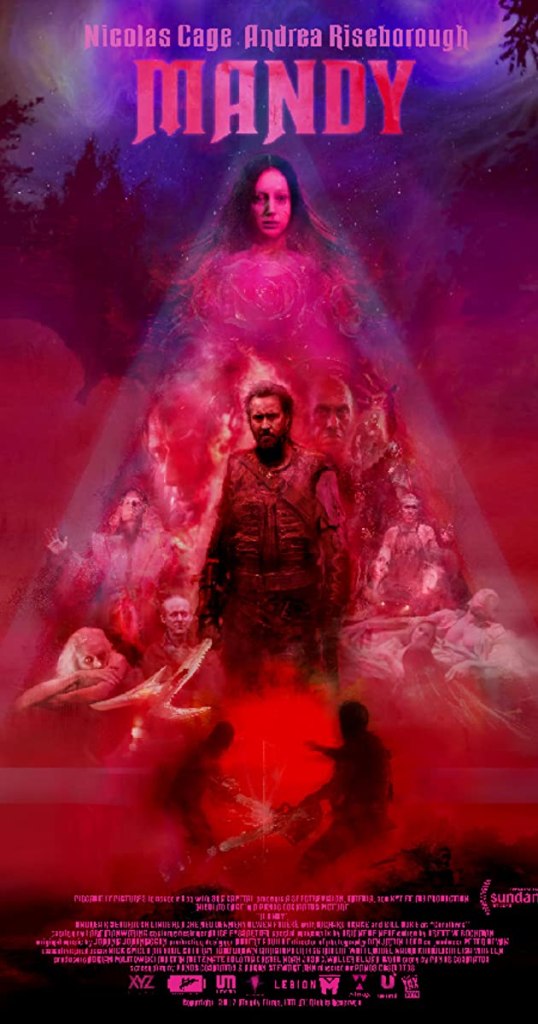
Let’s talk about Mandy.

Reccomendations

I want to talk about Mandy because I didn’t like Mandy. And at the same time I find myself thinking about it almost every day.

Mandy was recommended to me by a coworker after they tried to make a joke I didn’t understand pertaining to a fictional “Cheddar Goblin” that hawks boxed pasta a la Kraft mac n’cheese. Which is why I entered this movie expecting a cross between Gremlins and The Love Witch. That is not what Mandy is.

The movie has rave reviews from most of my horror sources, including my video store (shoutout Beyond Video) and Elijah Wood’s podcast, Visitations. I recommended it for a movie night with a friend and we tucked in for something I hoped would be little lighthearted, or at least original.

The visual effect of this movie is incredible, and if it were instead a series of still images that flashed on my television I would probably have enjoyed it more. I think about the visuals in Mandy all the time; the long black hair, the oversized Black Sabbath shirts, the scar, the sci-fi illustrations, the screeching purple color scheme, the house of windows tucked back in the woods, the very 1970s-esque feel of a place a little outside of time. There are elements of Twin Peaks here for sure, and elements of Holy Mountain.

I’m going to spoil Mandy now. She dies. She dies when a cult leader sees her walking along the side of the road and becomes obsessed with her. The cult breaks into her home, drugs her, and attempts to rape her. When she refuses, they burn her alive in front of her husband, fueling his vengeance rampage.

What Mandy is, when you pull back the aesthetic glazing of set and costume and lighting, is a movie where a woman is killed in order to give a man agency. It’s called the Disposable Woman Trope, and while Mandy herself is more of a character than many women summarily disposed, it fits this film still. It is brutal in its death scene, almost unwatchably so, and the bad guys commit such heinous atrocities that the pain of her demise is diminished under their unfathomable villainy. Elements of the very real dangers women face is part of what made me uncomfortable about Mandy. The reality is, I see myself in her as a potential victim of male entitlement and male violence, and I wonder that all the men who recommended this film to me do not.

I recognize that Mandy is based on splatter films of the 1970s, which became the torture porn of the 2000s that we loved so much in Hostel and Saw. I have never cared for torture porn, although I eat up the grotesque practical effects of The Thing and Return of the Living Dead. That’s to say, I see where it’s coming from. That doesn’t mean I like it.

But there is such a dreaminess to Mandy in all its electric glory. The movie has unexplained elements that hint at depth of narrative never touched on in the film. The characters’ backgrounds heavily inform their actions, and yet remain unknown to the viewer. There is a lot left unsaid.

In some ways I find myself wanting to live inside the image of this movie, where colors and actions have an underlying richness that is impossible in the real world. Only art can create that, can heighten it.

I think Mandy could have been great if it had built its own narrative path instead of relying so heavily on a sexist trope with no subversion. I was disappointed, ultimately, to find that something so promising and beautiful was actually hollow inside. It didn’t sit well with me. Yet here I am six months later still thinking about it all the time, so maybe it did its job.

Welcome to the Labor Camp

Archives and Libraries, Art

I am entering the second year of my Master’s in Library and Information Science, with a focus on archives and digital curation. One of the tools we use a lot is Omeka. Omeka is a platform used by galleries, libraries, archives, and museums to host digital materials and related metadata, as well as create exhibits. What it basically does is organize your stuff and let people search it from the comfort of their own home.

It’s also free. This means that everyone uses it. Every time I have a new Omeka project, I have to make a new account. I have made four – FOUR – separate Omeka accounts in the past year. I’m out of email addresses to sign up with. It’s truly madness.

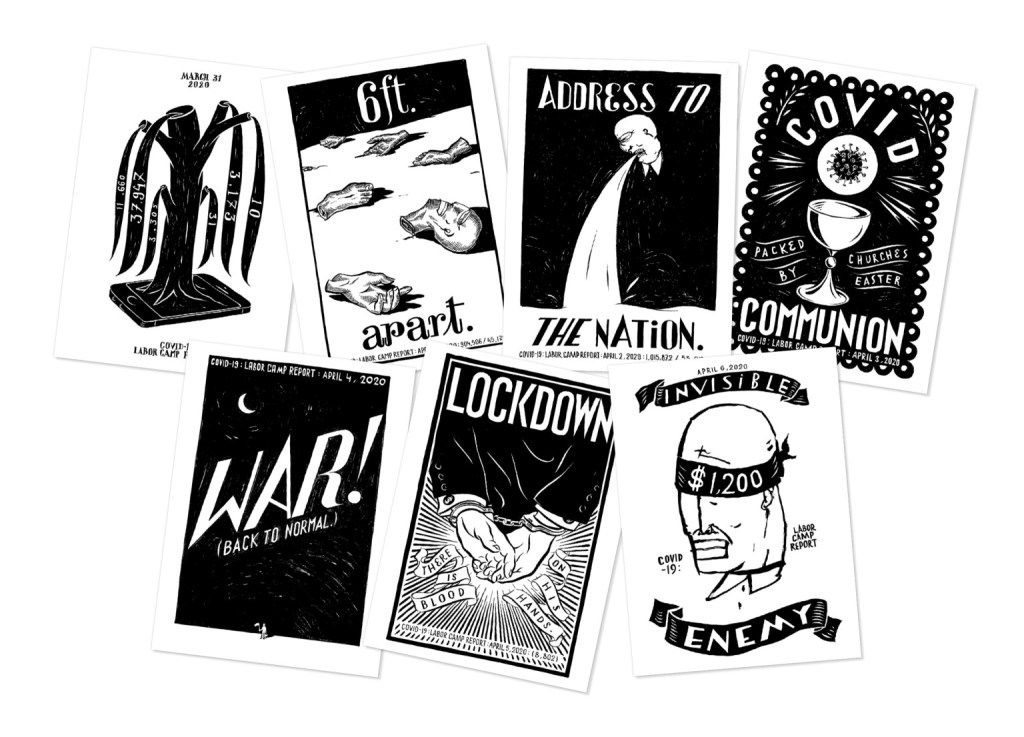
For my last Omeka project (hopefully ever) I created this exhibit about artist Pitor Szyhalki’s COVID-19 Labor Camp Reports. Szyhalski created a broadside a day from March 24 to November 3, 2020, responding to the myriad crises America faced almost daily as the COVID-19 death rate soared in the run up to the 2020 presidential election.

Welcome to the Labor Camp (exhibit link)

Post Typography in Baltimore printed and wheat-pasted the broadsides all over the neighborhoods I frequented this summer – Charles Village, Old Goucher, North Ave., Bolton Hill, Mt. Vernon – and that was where I first saw them plastered on breaker boxes as I biked up and down Howard Street.

I’m not going to say a whole lot more about these because most of what I have to say is covered in the exhibit, but these images astounded me. I do not have any rapid-response ability when it comes to art, so the perceptiveness of the pieces is doubly impressive. Szyhalski has an eye for graphic design and a mastery of visual language. There is a collected book in the works, and you can purchase selected posters on the Frank webpage, and follow on Instagram for the entire collection.

I go home alone

Reccomendations

Against all odds I bought a house this last year. The road to this goal was paved with the dead-end jobs, sexism, discrimination complaints, and devaluation of my work that consumed most of my 20s. There are many lessons bound up in there I hope no one else ever has to learn, and I have come out of it a harder, sharper, and more wary person because of it.

Against all odds I ended up in a stable, relatively well-paying position in an organization where I feel more genuinely supported in my professional goals than I ever have in my life. These experiences frame what I want to tell you about. 

I got tired of podcasts last week because I could not take one more voice in my head, at least not besides my own. So I dug up the last music that made me feel good, that gave me a genuine feeling of happiness – which was Florence and the Machine’s How Big, How Blue, How Beautiful.

In June 2019 Florence came to Merriweather Post in Columbia, which fell right between my exiting the bad job and starting the good one. I wore a long batik-print dress and danced barefoot on the lawn with my friends on a summer afternoon. It was a brief moment of absolutely no obligations to the universe, just sound and people and warm sunlight.

There is a song on that album I had almost forgotten about, but like most forgotten things it crept up on me while I was re-listening to the album in the car. It’s one of maybe two songs that will turn me to tears on contact. It is “South London Forever.”

“South London Forever” has a lot and absolutely nothing to do with South London, so much as it has to do with the fresh feeling of freedom in your early 20s curdling in the heat of crisis. The assumptions that I grew up with – going to college, getting a good job, getting married, buying a house – I began to realize were unattainable about the same time I began to realize I was an adult. Also about the time I realized winters were getting warmer and everything we thought we could have was just someone else’s memory.

This might not be the intention behind the song, but there are lines in “South London Forever” that were ripped right out of my own heart. I will not go through them all because to examine them would be to destroy them. This is just to say, I really love “South London Forever,” and I think you might too.

What We Don’t Have

Archives and Libraries

What We Don’t Have

I want to post this exhibit from Carnegie Mellon University because it is a strong example of how archives have historically and continue to uphold white supremacy and white histories, and how they can work to change this fact.

This exhibit is a not just an acknowledgement of the way white supremacy has marginalized diverse actors in the school’s history, but it is also a call to real action on the part of CMU to thoughtfully and collaboratively recognize a fuller story.

Archives are missing many histories. This stems from their origins as a means to uphold institutional power – especially in a culture where written documentation, literacy, and the ability to preserve physical objects form the foundations of that power. In this construction, people without the means to read, write, or preserve records are disenfranchised because they lack appropriate “evidence” of their own lived experiences.

Because of a tradition of ignoring marginalized communities and non-western modes of documentation, when members of these communities come to archives to find their histories, it’s oftentimes hard to help them. We simply do not have the records. This contributes to the idea that people who are non-white, non-western, and non-heteronormative simply did not exist in the past. It’s called “archival power;” the ability to codify history and shape collective memory according to a specific set of standards. It is a false image of history and it is detrimental. How can a community form a cohesive understanding of who they are without understanding where they have come from?

Time and time again the destruction of social histories has ripped apart the fabric of communities. It was evident in the proliferation of American Indian Boarding Schools in the US and Canada, and evident in the severing of families during chattel slavery the United States. Shared social histories provide stability and purpose, and are necessary to the human condition, understanding ourselves as individuals, and our place in a community. I think about how much I know about my own family history and how that shapes my self-image. It is the foundation that allows me to move through the world as an actualized person, and it has been taken away from so many people in favor of upholding a white, western status-quo.

This is changing as oral histories and alternative means of expression become recognized as valid documents of historical experience. Re-thinking what constitutes a “document” or record in archival parlance is essential to deconstructing traditional archival power. At the same time, CMU put it well when they say:

“Still, we acknowledge that for members of marginalized identity-based groups… it may be difficult to entrust the University Archives with their story when we do not have a history of engaging with them or recognizing their substantial contributions to campus life and culture.”

Relationships between power and communities is the most fraught part of rectifying these historical gaps. Marginalized groups have little reason to trust institutional archives when they have been at best ignored, and at worst actively harmed by these repositories.

During protests against a private police force at Johns Hopkins University in 2019, school archivists were in the crowd asking for donations of posters and other protest materials to the university archives. While the archivist side of me understood the impetus for rapid-response collecting, as an individual outside the institution (I lived about 4 blocks from campus at the time), the presence of university employees soliciting evidence of my involvement felt potentially dangerous.

How would these items be examined, cataloged, or presented in the future? Would names or faces be linked to individuals in a way that could lead to potentially harmful action against them? This certainly happend during Black Lives Matter protests, where video and photographic evidence posted to social media put activists and protesters in the sights of law enforcement long after they left the street. How could I be expected to trust the institution whose actions I was actively protesting? This is the gap many archives must work to rectify.

Without acknowledging past harm, recognizing and working to avoid the possibility of future harm, and rebuilding trust through thoughtful, meaningful, and mutually beneficial partnerships, there is little ground on which to stake reconciliation.

CMU is setting an action plan for this reconciliation. Only time will ultimately tell its success, but it is a powerful example of how archives – including mine – can be called to action in order to rectify past wrongs and create a fuller, more truthful, more impactful awareness of our shared history.

Lovecraft, Environmentalism, and Radiant Horror

Reccomendations

When I was rifling through boxes of books recently in a failed attempt to properly unpack them, I came across an H.P. Lovecraft anthology I did not remember owning. But my focus has been shot to hell recently (see: 2020) and short stories seemed about all I could handle. In October I worked through reading Lovecraft Country (not as good as I hoped) and then Victor LaValle’s novella, The Ballad of Black Tom (surpassing all expectation), both of which reckon with Lovecraft’s blatant racism – an unignorable factor in his writing.

I have never been into Lovecraft, although I remember trudging through The Dream-Quest of Unknown Kadath in college, but the anthology I found intrigued me and I spent a couple of weeks reading some of his more popular stories – At the Mountains of Madness, The Dunwich Horror, The Shadow Over Innsmouth. However, this is about one story that proved to be at the genesis of a narrative pattern I am constantly drawn to – The Color Out of Space.

Let’s actually start with the spring of 2016, when movie theaters were still open. The Charles in Baltimore was doing a revival of Stalker, a three-hour 1979 Andrei Tarkovsky film about three men walking through an alien minefield searching for an idol that will grant them their wish. I was in a new relationship at the time and I agreed to go mostly so I could sit next to this guy in the dark for three hours. But reader, I was hooked on this film (also, consequently, the guy). In retrospect, it’s a movie that works best in a dark theater. I cannot imagine trying to watch it at home, with your phone and your computer and your cat yelling at you and no strangers to shush.

From the first ten minutes I was drawn into its quiet dreary slowness, the constant sound of trickling water in a place left behind, bucolic but rife with unseen and unknowable danger. It is an obvious allegory for nuclear fallout. As it was released seven years before the Chernobyl disaster1 set the standard for fallout horror, watching it feels like a premonition.

I tell people about Stalker a lot, but it’s a hard sell. It is not paced for modern audiences; it doesn’t want to impress anybody. It’s more like an art film than a science fiction movie. Because of that I often recommend reading the 1972 novella it’s based on – Roadside Picnic by Arkady and Boris Strugatsky.

After seeing Stalker for the first time I went on a bit of a deep dive trying to find fiction akin to it. It is nominally sci-fi, but an odd kind of slow burn that is hard to pinpoint. The lesson is not heavy-handed, but it’s there; human influence on nature, the invisible havoc of industrial pollution, fallout, and waste. Rachel Carson released Silent Spring in 1962 and the environmental movement had birthed an awareness of our collective human tread, and a recognition of the vast web of life into which we were punching holes. Stalker built on these themes in a way that I can now only describe as Lovecraftian – the creeping horror – and it hit me deeply, pulling at my own latent anxieties. But it also lit a perverse hope. Perhaps we cannot destroy everything. Something new – however horrible – will at least remain.

It was not until I read Jeff VanderMeer’s Annihilation that I found anything close to it. My love of both the book and the 2018 movie are widely known because I will not shut up about them. I went so far as to download the soundtrack and listen to it on repeat for the better part of a year. Annihilation is in many ways the same movie as Stalker – a quest through alien dangers, a final goal, a transformation2. A lush landscape mired in deep wrongness by a twist in the scaffold of life – the “shimmer.” The very name recalls Lovecraft’s Color. The horror of it is best underlined for me by the bear, which terrified me so fully that I blocked out my memory of the entire scene until I finally watched the movie again six months later.

But where does Lovecraft come into all this? Over the summer I watched the new Color Out of Space adaptation starring Nic Cage. It was mostly on a lark – I cannot take Nic Cage seriously, and I had never even heard of the Lovecraft story. The movie does not match the artistry of either Stalker or Annihilation, but the lighting is otherworldly and Nic Cage yells a lot. It is equally slow-paced, if a little more grotesque. It felt to me like a rougher attempt to hit the same sweet note.

But the use of color in Lovecraft’s story is one of the most perceptive things about it – because nuclear radiation and color operate on the same electromagnetic spectrum. Ionizing radiation itself is beyond our sight, something malicious, incomprehensible, alien, especially in 1927 when Lovecraft wrote the story. When Marie Curie discovered radium twenty-eight years earlier, the pale blue glow became popular in everything from cosmetics to aircrafts3. Radium’s light-emitting properties were touted as beneficial, and users believed radiation itself was both visible and knowable, even as evidence of its invisible dangers mounted.

The world was caught between the promise of better living through science, and meddling with forces it did not have the means to control. This is Color Out of Space in a nutshell, and when I finally read it – actually read the original short story – I was so astonished, so ecstatic to find this kernel of inspiration for so much of the media I enjoy and I wanted to yell at someone for not telling me sooner.

We can get farther into nuclear semiotics or radiation accidents or genetic mutations, all of which influenced the piece I did in 2018 called Atomic Garden, but for now I’m just glad I found the narrative nexus on which so many of my favorite stories rest. If you have recommendations for books or movie based on these themes, please comment! If you have evidence of radiant horror before 1927 – I want to be all over that! Load me up with all your nuclear anxiety media, I am here for it.

Notes:
1see: Midnight in Chernobyl
2see: Hero’s Journey
3see: The Radium Girls