I want to talk about Mandy because I didn’t like Mandy. And at the same time I find myself thinking about it almost every day.
Mandy was recommended to me by a coworker after they tried to make a joke I didn’t understand pertaining to a fictional “Cheddar Goblin” that hawks boxed pasta a la Kraft mac n’cheese. Which is why I entered this movie expecting a cross between Gremlins and The Love Witch. That is not what Mandy is.
The movie has rave reviews from most of my horror sources, including my video store (shoutout Beyond Video) and Elijah Wood’s podcast, Visitations. I recommended it for a movie night with a friend and we tucked in for something I hoped would be little lighthearted, or at least original.
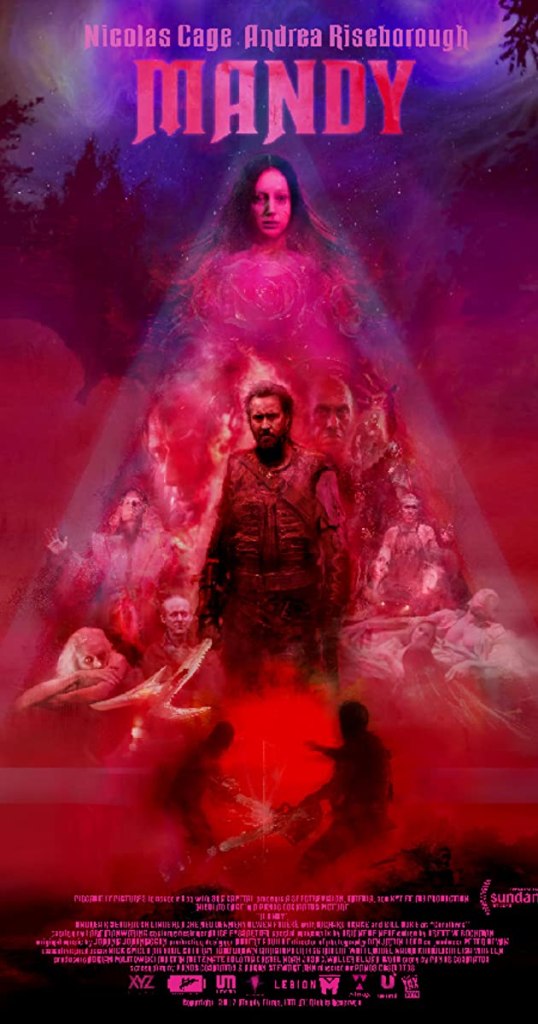
The visual effect of this movie is incredible, and if it were instead a series of still images that flashed on my television I would probably have enjoyed it more. I think about the visuals in Mandy all the time; the long black hair, the oversized Black Sabbath shirts, the scar, the sci-fi illustrations, the screeching purple color scheme, the house of windows tucked back in the woods, the very 1970s-esque feel of a place a little outside of time. There are elements of Twin Peaks here for sure, and elements of Holy Mountain.
I’m going to spoil Mandy now. She dies. She dies when a cult leader sees her walking along the side of the road and becomes obsessed with her. The cult breaks into her home, drugs her, and attempts to rape her. When she refuses, they burn her alive in front of her husband, fueling his vengeance rampage.
What Mandy is, when you pull back the aesthetic glazing of set and costume and lighting, is a movie where a woman is killed in order to give a man agency. It’s called the Disposable Woman Trope, and while Mandy herself is more of a character than many women summarily disposed, it fits this film still. It is brutal in its death scene, almost unwatchably so, and the bad guys commit such heinous atrocities that the pain of her demise is diminished under their unfathomable villainy. Elements of the very real dangers women face is part of what made me uncomfortable about Mandy. The reality is, I see myself in her as a potential victim of male entitlement and male violence, and I wonder that all the men who recommended this film to me do not.
I recognize that Mandy is based on splatter films of the 1970s, which became the torture porn of the 2000s that we loved so much in Hostel and Saw. I have never cared for torture porn, although I eat up the grotesque practical effects of The Thing and Return of the Living Dead. That’s to say, I see where it’s coming from. That doesn’t mean I like it.
But there is such a dreaminess to Mandy in all its electric glory. The movie has unexplained elements that hint at depth of narrative never touched on in the film. The characters’ backgrounds heavily inform their actions, and yet remain unknown to the viewer. There is a lot left unsaid.
In some ways I find myself wanting to live inside the image of this movie, where colors and actions have an underlying richness that is impossible in the real world. Only art can create that, can heighten it.
I think Mandy could have been great if it had built its own narrative path instead of relying so heavily on a sexist trope with no subversion. I was disappointed, ultimately, to find that something so promising and beautiful was actually hollow inside. It didn’t sit well with me. Yet here I am six months later still thinking about it all the time, so maybe it did its job.
 Allison E. Fischbach