I am entering the second year of my Master’s in Library and Information Science, with a focus on archives and digital curation. One of the tools we use a lot is Omeka. Omeka is a platform used by galleries, libraries, archives, and museums to host digital materials and related metadata, as well as create exhibits. What it basically does is organize your stuff and let people search it from the comfort of their own home.
It’s also free. This means that everyone uses it. Every time I have a new Omeka project, I have to make a new account. I have made four – FOUR – separate Omeka accounts in the past year. I’m out of email addresses to sign up with. It’s truly madness.
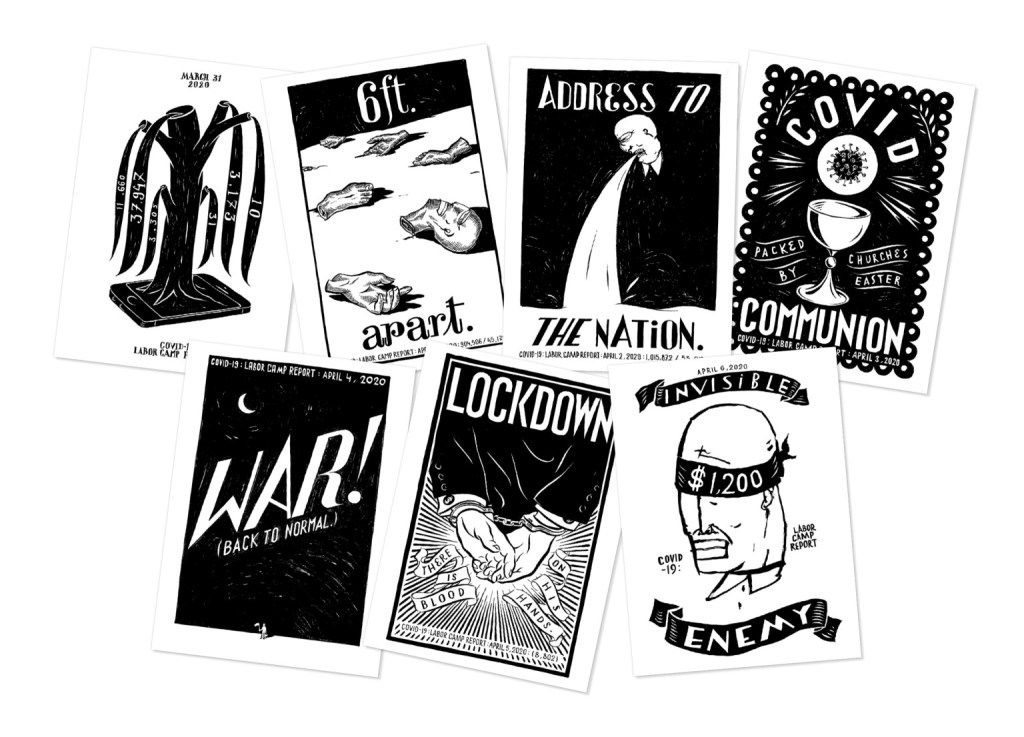
For my last Omeka project (hopefully ever) I created this exhibit about artist Pitor Szyhalki’s COVID-19 Labor Camp Reports. Szyhalski created a broadside a day from March 24 to November 3, 2020, responding to the myriad crises America faced almost daily as the COVID-19 death rate soared in the run up to the 2020 presidential election.
Welcome to the Labor Camp (exhibit link)
Post Typography in Baltimore printed and wheat-pasted the broadsides all over the neighborhoods I frequented this summer – Charles Village, Old Goucher, North Ave., Bolton Hill, Mt. Vernon – and that was where I first saw them plastered on breaker boxes as I biked up and down Howard Street.
I’m not going to say a whole lot more about these because most of what I have to say is covered in the exhibit, but these images astounded me. I do not have any rapid-response ability when it comes to art, so the perceptiveness of the pieces is doubly impressive. Szyhalski has an eye for graphic design and a mastery of visual language. There is a collected book in the works, and you can purchase selected posters on the Frank webpage, and follow on Instagram for the entire collection.
 Allison E. Fischbach